






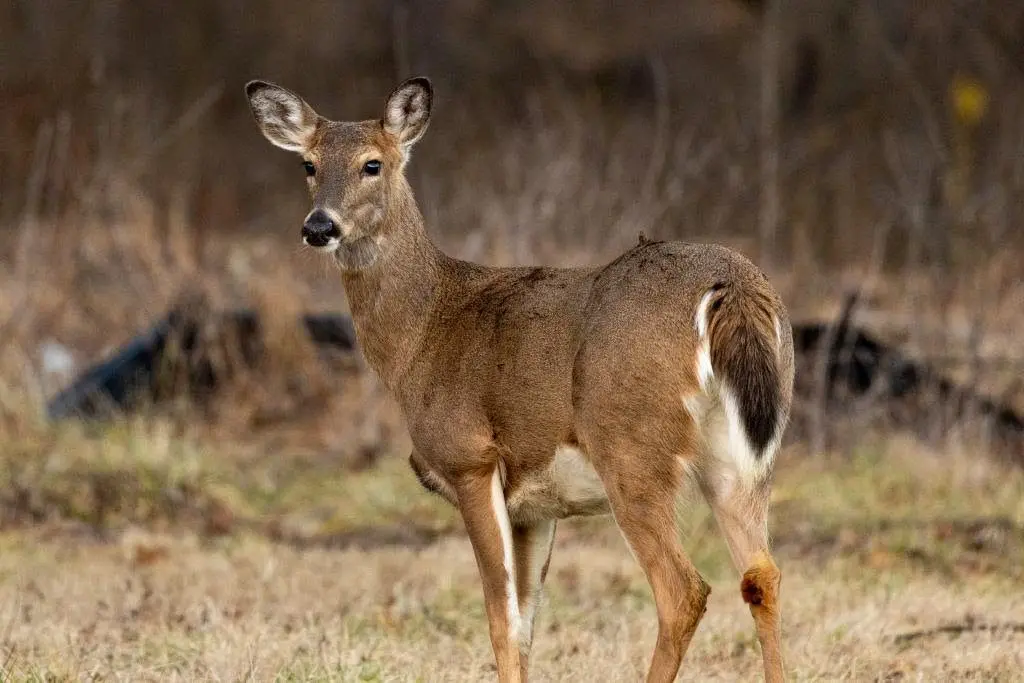
Hunters harvested 145,433 deer in Kentucky during the 2025-26 season, the fifth-highest reported total in history and 3,000 above the 10-year average.
The recently completed 136-day season was noteworthy for a newly expanded October youth-only season, impressive success of hunters on public land, and a high percentage of harvested bucks estimated to be 2½ years old or older.
But doe harvest goals, aimed at maintaining a healthy and quality herd, were not met.
“In many ways, it was a great deer season – almost 105,000 hunters were successful in taking at least one deer, walking away with meat in the freezer, some with a rack for the wall and all stories to tell friends and family,” said Joe McDermott, deer program coordinator for the Kentucky Department of Fish and Wildlife Resources.
“We are looking to substantially increase the female harvest over time, ” he said.
OVERALL HARVEST: The 145,433 total is less than last season’s 149,868 deer, which was the second only to the 155,730 taken in 2015. But this season’s total is well above the 10-year average of 142,412.
METHOD OF TAKE: The season began 30 minutes before sunrise Sept. 6, 2025 and came to a close 30 minutes after sundown on Jan. 19, 2026. The vast majority of deer were harvested during the 16-day modern gun season, Nov. 8-23, 2025. In all, 72 percent of deer were killed with modern guns, 11 percent with bows, 10 percent with crossbows and 6 percent with muzzleloaders.
IN-STATE HUNTERS: Kentucky residents accounted for 80 percent of successful hunters, while non-residents accounted for 15 percent. That breakdown has been consistent over the last decade. The other 5 percent were either unknown or youth.
PUBLIC LANDS: Nearly 7,400 deer – about 5 percent of the reported harvest – were taken on public lands, second only to the previous season’s 7,767 deer. The state-maintained Wildlife Management Areas (WMAs) with the highest figures were Peabody (574), Taylorsville Lake (239), Green River Lake (234), Clay (210) and Barren River Lake (192).
BUCK AGES: Of male deer harvested, 69.5 percent were estimated to be 2½ years old or older, 21 percent were yearlings and 9.5 percent were male fawns.
BY REGION: The Bluegrass Region accounted for 28 percent of the harvest, followed by the Green River Region at 27 percent, the Southeast Region at 18 percent, the Purchase Region at 14 percent and the Northeast Region at 12 percent.
TOP TEN COUNTIES: For the fifth time in seven seasons, Hardin County finished with the highest harvest with 3,543 deer, followed by Breckinridge (3,090), Christian (2,998), Hart (2,814), Graves (2,698), Shelby (2,692), Washington (2,662), Pendleton (2,642), Nelson (2,590) and Hopkins (2,484) counties.
EARLY YOUTH SEASON: This season, the October early youth firearms season expanded from two days to nine days, Oct. 11-Oct. 19, 2025. McDermott said youth killed 5,645 deer during those nine days, an increase of approximately 2,000 deer from previous two-day totals. But that increase was offset by a reduction of about 1,500 deer harvested in the overlapping two-day muzzleloader season (Oct. 18-19). Unusually warm weather may have played a part, but it’s also likely that adult hunters elected to sit with youth rather than hunt themselves, he said.
EARLY CWD SEASON: Hunters took 576 deer taken during a special two-day, antlerless-only firearms season established Sept. 27-28, 2025 in the 14 counties that made up Kentucky’s Chronic Wasting Disease Surveillance Zones at that time, partly to obtain samples to be tested for CWD.
DOE HARVEST: Only 43.5 percent of deer harvested were female. Wildlife officials want more does harvested in the state’s 51 Zone 1 counties to reduce deer populations there and in the 35 Zone 2 counties to maintain their current populations. Of Kentucky’s four deer zones, Zone 1 has the highest deer densities while Zone 4 has the lowest.
This year, Fish and Wildlife set doe harvest goals for Zone 1 and Zone 2 counties, but only one county – Simpson – met its goal. Eleven other counties met 80 to 90 percent of the department’s goals.
McDermott said wildlife officials are discussing ways to increase doe harvest. More than 20 counties are expected to be reassigned to different zones to encourage more doe harvest in the 2026-27 deer season.
An overabundance of deer can result in increased deer-vehicle collisions and damage to agricultural crops and expensive landscaping. It can also increase the spread of tick-born and other diseases and lead to smaller body sizes and antlers due to competition for food.
“When there are fewer deer on the landscape, the remaining animals are better able to reach their full potential,” McDermott said.
HUNTER SUCCESS: Of the 104,595 successful deer hunters, 74 percent took only one deer, less than 43 percent took a doe and less than 3 percent filled their standard four-deer permit allotment, said Tommy Apostolopoulos, deer program biologist.
As a reminder, hunters who take more deer than they need can donate a deer to Kentucky Hunters for the Hungry or Boone Brothers, two organizations working together to fight food insecurity.
Note: Hunters can view the online Harvest Results page for in-depth statistics based on county, hunting method, year and more.